
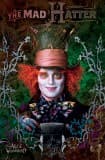
Alice in Wonderland (2010)
Synopsis
In Tim Burton's visually stunning adaptation of "Alice in Wonderland," the story follows a young girl named Alice Kingsleigh, who returns to the whimsical world she first visited as a child. Now a teenager, Alice finds herself in a fantastical realm filled with peculiar creatures and vibrant landscapes. As she navigates this surreal environment, she encounters iconic characters such as the Mad Hatter, the Cheshire Cat, and the Red Queen, each with their own unique quirks and challenges. Tasked with defeating the tyrannical Red Queen and restoring order to Wonderland, Alice embarks on a journey of self-discovery, courage, and imagination. This enchanting tale blends adventure and fantasy, inviting viewers to explore the boundaries of reality and the power of belief.
What is the budget of Alice in Wonderland?
Tim Burton's 2010 adaptation of "Alice in Wonderland" captivated audiences with its stunning visuals and imaginative storytelling. Featuring a talented cast that includes Mia Wasikowska as Alice, Johnny Depp as the Mad Hatter, and Helena Bonham Carter as the Red Queen, this film was released on March 5, 2010. The budget of this cinematic adventure is particularly noteworthy, as it reflects the ambitious scale of the production and its subsequent financial performance.
What was the production budget?
The production budget for "Alice in Wonderland" was a staggering $200,000,000. This figure places it among the higher echelons of film budgets, especially for fantasy films. When compared to other movies in the genre, such as "Avatar" (2009) with a budget of around $237 million and "The Chronicles of Narnia: Prince Caspian" (2008) at approximately $225 million, "Alice in Wonderland" stands out for its unique blend of live-action and CGI.
Key Budget Allocation Categories
While specific breakdowns of the budget are not publicly available, several key factors typically contribute to the overall production costs:
- Special Effects: Given the film's fantastical elements, a significant portion of the budget was allocated to visual effects and animation.
- Talent: The star-studded cast and renowned director commanded high salaries, contributing to the overall costs.
- Set Design and Locations: Creating the whimsical world of Wonderland required extensive set design and location shooting.
What were the major cost factors?
Several elements drove the production costs of "Alice in Wonderland":
- Special Effects: The film utilized cutting-edge technology to create its vibrant visuals, which likely accounted for a large part of the budget.
- Notable Scenes: The Mad Hatter's tea party and the climactic battle scenes were particularly expensive to produce due to their complexity and the need for extensive CGI.
- Budget Challenges: Like many large-scale productions, "Alice in Wonderland" faced challenges that could have led to budget overruns, although specific details on overruns are not widely reported.
How did the box office perform?
The financial success of "Alice in Wonderland" is evident in its box office performance. The film grossed an impressive $1,025,491,110 worldwide, with $334,191,110 coming from domestic earnings.
Break-even Point Analysis
To determine the break-even point, a film typically needs to earn about twice its production budget to cover marketing and distribution costs. For "Alice in Wonderland," this means it needed to gross approximately $400 million. With its total earnings surpassing this figure, the film was a commercial success.
ROI Percentage
The return on investment (ROI) for "Alice in Wonderland" can be calculated as follows:
- Total Earnings: $1,025,491,110
- Production Budget: $200,000,000
- ROI: \[(Total Earnings - Production Budget) / Production Budget\] x 100 = \[(1,025,491,110 - 200,000,000) / 200,000,000\] x 100 = 412.75%
Was the movie profitable?
Absolutely, "Alice in Wonderland" was profitable. The film not only recouped its production costs but also generated substantial earnings, making it a financial success for Disney and the associated production companies.
Impact on the Studio and Franchise
The success of "Alice in Wonderland" had a significant impact on Disney, reinforcing the viability of high-budget fantasy adaptations. This success likely influenced future projects, leading to increased budgets for similar films in the genre.
Records Set
Upon its release, "Alice in Wonderland" set several records, including the highest-grossing opening weekend for a film released in March at the time, showcasing its widespread appeal.
Commonly Asked Questions
How much did Alice in Wonderland (2010) cost to make?
The production cost of "Alice in Wonderland" was $200,000,000.
Was Alice in Wonderland (2010) profitable?
Yes, the film was highly profitable, grossing over $1 billion worldwide.
What was the most expensive element of Alice in Wonderland (2010)?
The most expensive elements likely included special effects and the salaries of the star-studded cast.
How much did Alice in Wonderland (2010) make at the box office?
The film earned approximately $1,025,491,110 globally.
Did Alice in Wonderland (2010) go over budget?
While specific details on budget overruns are not widely reported, the film's ambitious nature suggests that it faced challenges typical of large productions.
In summary, "Alice in Wonderland" stands as a remarkable example of high-budget filmmaking, blending creativity with financial success. Its impressive box office performance and significant ROI highlight the potential rewards of investing in visually stunning and imaginative storytelling.

























Budget Templates
Build your own production budget
Create professional budgets with AICP and feature film templates. Real-time collaboration, no spreadsheets.
Start Budgeting Free