
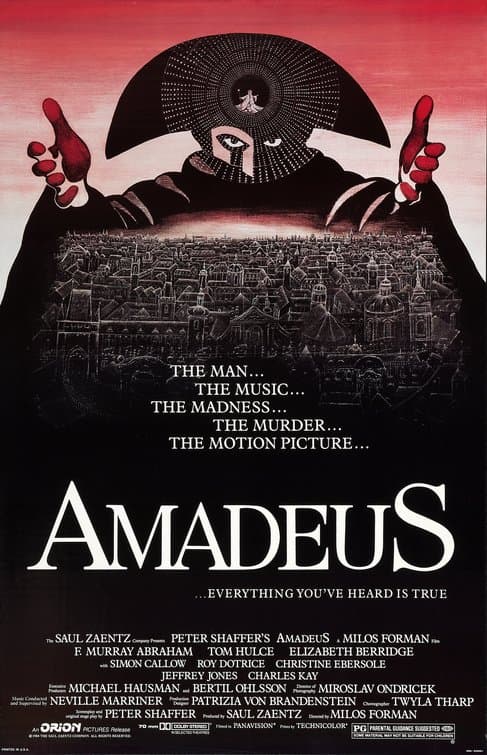
Amadeus (1984)
Synopsis
"Amadeus" (1984) is a captivating historical drama that delves into the life of the legendary composer Wolfgang Amadeus Mozart, as seen through the eyes of his rival, Antonio Salieri. Set in 18th-century Vienna, the film explores themes of jealousy, genius, and the struggle for recognition in the world of classical music. Salieri, a devout man who has dedicated his life to music, becomes increasingly envious of Mozart's extraordinary talent and carefree lifestyle. As he grapples with his own mediocrity, Salieri's obsession with Mozart leads to a complex relationship filled with admiration, resentment, and ultimately, betrayal. The film masterfully intertwines the beauty of Mozart's compositions with the darker aspects of human emotion, creating a rich tapestry that highlights the price of genius and the fragility of artistic legacy.
What is the budget of Amadeus?
"Amadeus" (1984) stands as a remarkable film that intricately portrays the life of Wolfgang Amadeus Mozart through the perspective of his rival, Antonio Salieri. Directed by Milos Forman, this historical drama features stellar performances from F. Murray Abraham as Salieri and Tom Hulce as Mozart. Released on September 19, 1984, the film not only captivated audiences but also raised questions about the financial aspects of its production. Understanding the budget of "Amadeus" provides insight into its financial success and the impact it had on the film industry.
What was the production budget of Amadeus?
The production budget for "Amadeus" was set at $18,000,000. This figure places it within a moderate range for films of its time, especially considering its genre. When compared to other historical dramas released in the 1980s, "Amadeus" had a budget that was competitive yet reflective of the film's ambitious scope and artistic aspirations.
How does this compare to similar films in the genre?
In the realm of historical dramas, budgets can vary significantly. For instance, films like "The Killing Fields" (1984) had a budget of around $6 million, while "Gandhi" (1982) boasted a budget of approximately $22 million. "Amadeus" found itself in a sweet spot, allowing for high production values while still being mindful of costs.
What were the major cost factors in Amadeus?
Several key factors contributed to the overall production costs of "Amadeus":
- Set Design and Locations: The film required authentic 18th-century Vienna settings, which involved extensive set design and location scouting.
- Costumes: Period-accurate costumes were essential to convey the film's historical context, adding to the budget.
- Talent: The film featured a talented cast and crew, which naturally influenced the overall costs.
Were there any notable expensive scenes or elements?
One of the most expensive elements of "Amadeus" was the orchestral performances, which required skilled musicians and elaborate staging. The film's climactic scenes, showcasing Mozart's compositions, demanded meticulous attention to detail, further driving up production costs.
Did Amadeus go over budget?
While "Amadeus" was produced within its initial budget, the complexities of filming and the need for high-quality production values posed challenges. However, it managed to stay relatively close to the original budget without significant overruns.
How did Amadeus perform at the box office?
"Amadeus" achieved impressive box office earnings, grossing $51,973,029 domestically. This figure reflects its strong reception among audiences and critics alike.
What was the domestic vs. international breakdown?
The film's domestic earnings were substantial, but it also performed well internationally, contributing to its overall financial success. The exact international box office figures are not specified, but the film's acclaim helped it reach a wider audience.
What was the break-even point analysis?
To determine the break-even point, one must consider marketing and distribution costs, which can often double the production budget. Given its $18 million budget, "Amadeus" likely needed to gross around $36 million to break even, a target it surpassed comfortably.
What is the ROI percentage?
With a domestic box office of approximately $51.9 million, the return on investment (ROI) for "Amadeus" can be calculated. The ROI percentage stands at around 188%, indicating a highly successful financial outcome.
Was Amadeus profitable?
Yes, "Amadeus" was indeed profitable. The film not only recouped its production costs but also generated significant earnings, solidifying its status as a financial success.
How did it affect the studio/franchise?
The success of "Amadeus" had a positive impact on the Saul Zaentz Company, enhancing its reputation for producing high-quality films. The film's acclaim also paved the way for future projects within the historical drama genre.
What impact did it have on future movie budgets in the genre?
The financial success of "Amadeus" demonstrated that historical dramas could achieve both critical and commercial success, encouraging studios to invest more in similar projects. This shift likely influenced budget allocations for subsequent films in the genre.
Did Amadeus set any records?
While "Amadeus" may not have set specific box office records, it did win eight Academy Awards, including Best Picture, which further solidified its legacy in cinematic history.
Commonly Asked Questions
How much did Amadeus (1984) cost to make?
The production cost of "Amadeus" was $18,000,000.
Was Amadeus (1984) profitable?
Yes, "Amadeus" was profitable, grossing over $51 million at the box office.
What was the most expensive element of Amadeus (1984)?
The orchestral performances and period-accurate set designs were among the most expensive elements.
How much did Amadeus (1984) make at the box office?
"Amadeus" earned approximately $51,973,029 domestically.
Did Amadeus (1984) go over budget?
No, "Amadeus" managed to stay close to its initial budget of $18 million.
Understanding the financial aspects of "Amadeus" not only highlights its success but also provides valuable insights into the filmmaking process and the historical drama genre.
Plan Your Own Film Budget
Looking to manage a real production? [Saturation](https://saturation.io) is cloud-based film budgeting software built for producers — with collaborative budgets, expense tracking, and production banking in one place. [Start free](https://app.saturation.io/signup).

































Budget Templates
Build your own production budget
Create professional budgets with AICP and feature film templates. Real-time collaboration, no spreadsheets.
Start Budgeting Free