
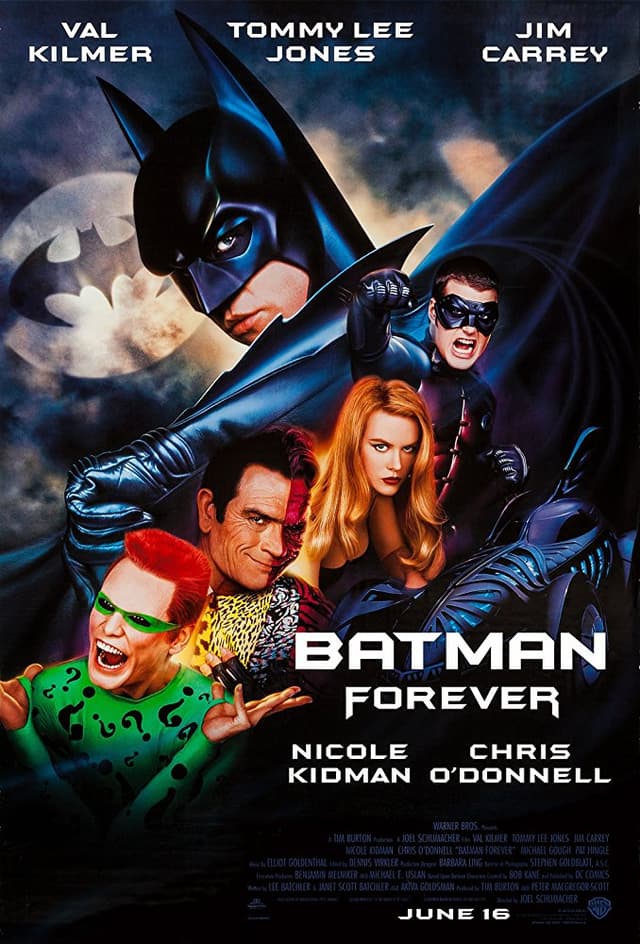
Batman Forever (1995)
Synopsis
The Riddler teams up with Two-Face to bring down Batman and drain the minds of Gotham City residents with his device, while Batman gets some much-needed help in the form of circus performer Dick Grayson, out for vengeance after being orphaned by Two-Face.
What is the budget of Batman Forever?
Batman Forever, released in 1995, marked a significant chapter in the Batman franchise. Directed by Joel Schumacher, this film featured a star-studded cast including Val Kilmer as Batman, Jim Carrey as The Riddler, and Tommy Lee Jones as Two-Face. The movie not only captivated audiences with its unique take on the iconic superhero but also made headlines for its substantial budget. Understanding the budget of Batman Forever is crucial, as it reflects the film's production scale and its impact on the box office.
What was the production budget of Batman Forever?
The production budget for Batman Forever was a staggering $100,000,000. This figure places it among the higher echelons of superhero films from the 1990s. When compared to other films in the genre, such as Batman Returns (1992), which had a budget of approximately $80 million, Batman Forever's budget illustrates the increasing financial commitment studios were willing to make for blockbuster superhero films.
Key Budget Allocation Categories
While specific breakdowns of the budget are not publicly available, several key factors typically contribute to such high production costs:
- Special Effects: The film featured numerous special effects, particularly in scenes involving The Riddler's mind-draining device.
- Talent: The salaries of high-profile actors and the director significantly impacted the budget.
- Set Design and Locations: The elaborate Gotham City sets and various filming locations added to the overall costs.
What were the major cost factors in Batman Forever?
Several elements contributed to the production costs of Batman Forever:
- Special Effects: The film's visual effects, including the elaborate action sequences and the design of The Riddler's technology, were significant expenses.
- Costumes and Makeup: The iconic costumes, particularly Batman's suit and the elaborate makeup for Two-Face, required substantial investment.
- Filming Locations: The production utilized various locations, which often incurs additional costs.
Notable scenes, such as the climactic battles and the introduction of Dick Grayson, required extensive resources, further straining the budget. Initial estimates suggested a lower budget, but as production progressed, costs escalated, leading to challenges in staying within financial limits.
How did Batman Forever perform at the box office?
Batman Forever achieved impressive box office earnings, grossing $336,529,144 worldwide. The domestic box office alone accounted for $184,031,112 of this total.
Break-even Point Analysis
To determine the film's financial success, it's essential to consider the break-even point. Typically, a film needs to earn about twice its production budget to cover marketing and distribution costs. In this case, Batman Forever needed to gross approximately $200 million to break even, which it surpassed comfortably.
ROI Percentage
The return on investment (ROI) for Batman Forever can be calculated as follows:
- Total Earnings: $336,529,144
- Production Budget: $100,000,000
- ROI: \[(Total Earnings - Production Budget) / Production Budget\] x 100 = \[(336,529,144 - 100,000,000) / 100,000,000\] x 100 = 236.53%
Was Batman Forever profitable?
Yes, Batman Forever was indeed profitable. The film's box office performance not only recouped its production costs but also generated significant earnings for Warner Bros. This success had a lasting impact on the studio and the franchise, paving the way for future Batman films and influencing budget allocations for superhero movies in the years to come.
Impact on Future Movie Budgets
The financial success of Batman Forever set a precedent for subsequent superhero films, leading studios to invest even more heavily in production budgets. The film demonstrated that audiences were willing to support high-budget superhero narratives, encouraging studios to push the envelope in terms of special effects and star power.
Commonly Asked Questions
How much did Batman Forever (1995) cost to make?
The production cost of Batman Forever was $100,000,000.
Was Batman Forever (1995) profitable?
Yes, the film was profitable, grossing over $336 million worldwide.
What was the most expensive element of Batman Forever (1995)?
While specific figures are not disclosed, special effects and talent salaries were likely among the most expensive elements.
How much did Batman Forever (1995) make at the box office?
Batman Forever earned $336,529,144 globally.
Did Batman Forever (1995) go over budget?
The film faced budget challenges, with initial estimates lower than the final production cost of $100 million.
In summary, Batman Forever stands as a significant financial success in the superhero genre, with its budget and box office performance reflecting the evolving landscape of blockbuster filmmaking. The film not only entertained audiences but also reshaped the financial strategies of studios in the years that followed.























Budget Templates
Build your own production budget
Create professional budgets with AICP and feature film templates. Real-time collaboration, no spreadsheets.
Start Budgeting Free