
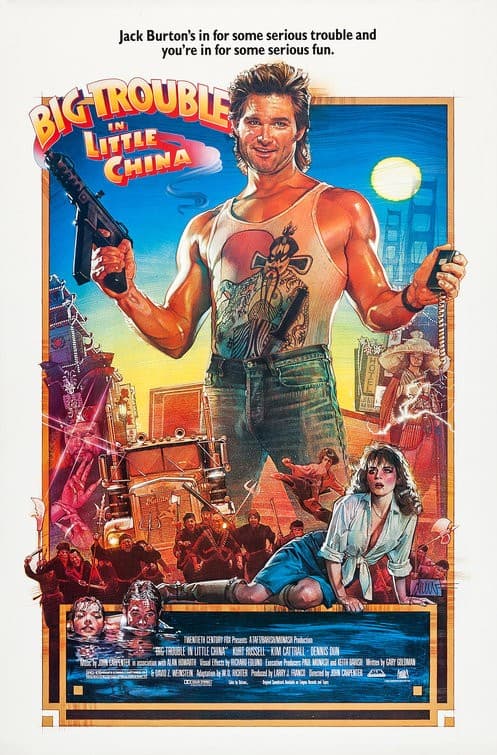
Big Trouble in Little China
Synopsis
"Big Trouble in Little China" is a cult classic action-comedy film directed by John Carpenter, released in 1986. The story follows Jack Burton, a brash truck driver played by Kurt Russell, who unwittingly becomes embroiled in a supernatural battle in San Francisco's Chinatown. When his friend Wang Chi's fiancée, Miao Yin, is kidnapped by a powerful sorcerer named Lo Pan, Jack teams up with Wang to rescue her.
As they navigate the vibrant and mystical underworld of Chinatown, they encounter a host of eccentric characters, including a trio of ancient warriors and a mysterious woman named Gracie Law. The film blends martial arts, humor, and fantasy elements, showcasing Jack's over-the-top bravado and comedic misadventures. Ultimately, "Big Trouble in Little China" is a wild ride filled with action, memorable one-liners, and a unique take on the hero's journey, making it a beloved staple in the realm of 80s cinema.
What is the budget of Big Trouble in Little China?
"Big Trouble in Little China" has earned its place as a cult classic since its release in 1986. Directed by the legendary John Carpenter, the film stars Kurt Russell as the brash truck driver Jack Burton, who finds himself in a supernatural showdown in San Francisco's Chinatown. The movie's unique blend of action, comedy, and fantasy elements has captivated audiences for decades. Understanding the budget behind this iconic film reveals much about its production and financial journey.
What was the production budget?
The production budget for "Big Trouble in Little China" was set at $25 million. This figure places it within a moderate range for action-comedy films of the mid-1980s. For comparison, films like "Ghostbusters" (1984) had a budget of around $30 million, while "The Goonies" (1985) was produced for approximately $19 million. The budget for "Big Trouble in Little China" reflects the ambition of its special effects and elaborate set designs, which were essential for bringing the film's fantastical elements to life.
Key Budget Allocation Categories
While specific breakdowns of the budget are not widely available, several key factors contributed to the overall production costs:
- Special Effects: The film featured numerous practical effects and stunts, which were significant budget items.
- Locations: Filming in San Francisco's Chinatown required permits and logistical planning, adding to the costs.
- Talent: The cast, including Kurt Russell and Kim Cattrall, commanded substantial salaries, impacting the budget.
What were the major cost factors?
Several elements contributed to the production costs of "Big Trouble in Little China." Notable expenses included:
- Special Effects: The film's supernatural elements required innovative effects, which were costly to produce.
- Set Design: Creating the vibrant and mystical world of Chinatown involved extensive set construction and design.
- Stunts and Action Sequences: The film's action scenes, including martial arts choreography, necessitated skilled stunt performers and safety measures.
Despite the initial budget of $25 million, the film faced challenges that led to some budget overruns, particularly in the special effects department.
How did the film perform at the box office?
"Big Trouble in Little China" grossed approximately $11,208,967 worldwide, with $11,100,000 coming from the domestic box office. This performance fell short of its production budget, leading to a significant financial loss.
Break-even Point Analysis
To break even, a film typically needs to earn about twice its production budget when considering marketing and distribution costs. In this case, "Big Trouble in Little China" would have needed to gross around $50 million to be considered financially successful.
ROI Percentage
Given the production budget and box office earnings, the return on investment (ROI) for "Big Trouble in Little China" is negative. The film's financial performance did not meet expectations, resulting in a loss for the studio.
Was the movie profitable?
"Big Trouble in Little China" was not profitable at the box office. The film's earnings of $11,208,967 were significantly lower than its production costs, leading to a financial shortfall.
Impact on the Studio and Franchise
Despite its initial box office failure, the film gained a cult following over the years, influencing future projects and contributing to the legacy of John Carpenter's work. The film's unique style and memorable characters have inspired various adaptations and merchandise, showcasing its lasting impact.
Future Movie Budgets in the Genre
The financial outcome of "Big Trouble in Little China" may have influenced how studios approached budgets for similar films in the years that followed. The blend of action and comedy, along with supernatural elements, became a more cautious investment for studios, leading to more conservative budgeting in the genre.
Commonly Asked Questions
How much did Big Trouble in Little China cost to make?
The production cost of "Big Trouble in Little China" was $25 million.
Was Big Trouble in Little China profitable?
No, the film was not profitable, grossing only $11,208,967 at the box office.
What was the most expensive element of Big Trouble in Little China?
The most expensive elements likely included special effects and set design, which were crucial for the film's supernatural themes.
How much did Big Trouble in Little China make at the box office?
The film earned approximately $11,208,967 worldwide.
Did Big Trouble in Little China go over budget?
While the initial budget was $25 million, the film faced challenges that likely led to some budget overruns, particularly in special effects.
In summary, "Big Trouble in Little China" serves as a fascinating case study in film budgeting and box office performance. Despite its financial struggles upon release, the film's enduring popularity highlights the unpredictable nature of cinematic success.

































Budget Templates
Build your own production budget
Create professional budgets with AICP and feature film templates. Real-time collaboration, no spreadsheets.
Start Budgeting Free