
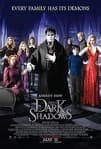
Dark Shadows (2012)
Synopsis
In the year 1750, Joshua and Naomi Collins, with young son Barnabas, set sail from England to start a new life in America, where they build a fishing empire in the coastal Maine town that comes to carry their name: Collinsport. Two decades pass and Barnabas has the world at his feet. The master of Collinwood Manor, Barnabas is rich, powerful and an inveterate playboy… until he makes the grave mistake of falling in love with a beauty named Josette DuPres and breaking the heart of Angelique Bouchard. A witch in every sense of the word, Angelique dooms him to a fate worse than death—turning him into a vampire, and then burying him… alive. Nearly two centuries later, Barnabas is inadvertently freed from his tomb and emerges into the very changed world of 1972, a stranger in an even stranger time. Returning to Collinwood Manor, he finds that his once-grand estate has fallen into ruin, and the dysfunctional remnants of the Collins family have fared little better, each harboring their own dark secrets. As Barnabas sets out to restore his family name to its former glory, one thing stands in his way: Collinsport’s leading denizen, who goes by the name Angie…and who bears a striking resemblance to a very old acquaintance of Barnabas Collins.
What is the budget of Dark Shadows?
Dark Shadows (2012) is a unique blend of gothic horror and comedy, directed by the renowned Tim Burton. The film features a star-studded cast, including Johnny Depp, Michelle Pfeiffer, and Eva Green. Released on May 11, 2012, this adaptation of the classic soap opera carries a significant budget that reflects its ambitious production. Understanding the budget of Dark Shadows is crucial for grasping its financial performance and impact on the film industry.
What was the production budget?
The production budget for Dark Shadows was a staggering $150,000,000. This figure places it among the higher echelons of film budgets, particularly for a genre that combines elements of horror and comedy. When compared to similar films, such as Burton's own Alice in Wonderland, which had a budget of around $200 million, Dark Shadows aimed to deliver a visually captivating experience while maintaining a more modest financial footprint.
Key Budget Allocation Categories
While specific breakdowns of budget allocation are not publicly available, several key factors typically contribute to the overall production costs:
- Special Effects: Given the supernatural elements of the story, significant resources were likely allocated to visual effects.
- Locations: Filming in various locations, including elaborate sets and historical sites, would have added to the costs.
- Talent: The involvement of high-profile actors and a skilled production team often leads to increased expenses.
What were the major cost factors?
Several elements contributed to the overall production costs of Dark Shadows:
- Special Effects: The film's supernatural themes required advanced visual effects, which can be quite costly.
- Set Design: Creating the iconic Collinwood Manor and other settings demanded substantial investment in set design and construction.
- Talent Salaries: With a cast featuring A-list actors, salaries would have constituted a significant portion of the budget.
Notable scenes, such as those involving elaborate transformations and supernatural confrontations, likely required extensive resources, further driving up production costs. While the initial budget was set at $150 million, the final costs may have exceeded this figure due to unforeseen challenges during production.
How did Dark Shadows perform at the box office?
Dark Shadows grossed $245,564,215 worldwide, with $79,727,149 coming from domestic earnings. This performance indicates a mixed reception at the box office, as the film did not reach its break-even point, which is typically estimated to be around 2.5 times the production budget.
Break-even Point Analysis
To determine the break-even point, we can calculate:
- Break-even Point: Approximately $375 million (2.5 x $150 million)
- Total Earnings: $245,564,215
This analysis shows that Dark Shadows fell short of its break-even point, resulting in a financial loss for the studio.
Was Dark Shadows profitable?
Given the box office performance, Dark Shadows was not profitable. The film's earnings did not cover its production costs, leading to a financial setback for the studio. This outcome may have influenced future budget decisions for similar films within the genre.
Impact on the Studio and Franchise
The financial underperformance of Dark Shadows likely prompted Warner Bros. and other studios to reassess their investment strategies in high-budget genre films. While the film did not achieve the desired success, it remains a notable entry in Tim Burton's filmography.
Commonly Asked Questions
How much did Dark Shadows (2012) cost to make?
The production cost of Dark Shadows was $150,000,000.
Was Dark Shadows (2012) profitable?
No, Dark Shadows did not turn a profit, as its box office earnings fell short of its production costs.
What was the most expensive element of Dark Shadows (2012)?
While specific figures are not disclosed, special effects and talent salaries likely constituted the most significant expenses.
How much did Dark Shadows (2012) make at the box office?
The film grossed $245,564,215 worldwide.
Did Dark Shadows (2012) go over budget?
While the initial budget was $150 million, it is possible that final costs exceeded this amount due to various production challenges.
In summary, Dark Shadows (2012) serves as a fascinating case study in film budgeting and box office performance. Despite its high production costs and star-studded cast, the film struggled to achieve financial success, highlighting the unpredictable nature of the film industry.




























Budget Templates
Build your own production budget
Create professional budgets with AICP and feature film templates. Real-time collaboration, no spreadsheets.
Start Budgeting Free
.png&w=1200&q=75)