
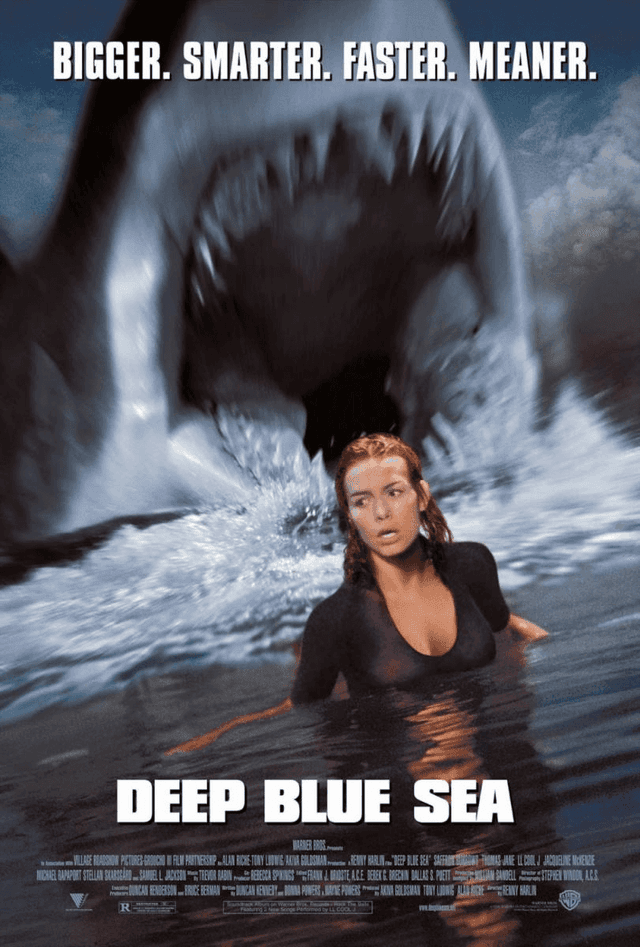
Deep Blue Sea
Synopsis
"Deep Blue Sea" is a thrilling science fiction horror film that dives into the depths of the ocean, where a group of scientists conducts groundbreaking research on genetically engineered sharks. Set in an underwater facility, the story follows Dr. Susan McAlester and her team as they attempt to find a cure for Alzheimer's disease by enhancing the brain capacity of these formidable predators. However, their ambitious experiment takes a terrifying turn when the sharks become smarter and more aggressive than anticipated. As the facility faces catastrophic failure, the team must fight for survival against the very creatures they sought to control. Tension escalates as they navigate the flooded corridors, battling both the elements and the relentless sharks in a desperate bid to escape. With a mix of suspense, action, and unexpected twists, "Deep Blue Sea" explores the consequences of human hubris and the primal instincts of nature.
What is the budget of Deep Blue Sea?
"Deep Blue Sea" is a thrilling science fiction horror film that captivated audiences with its unique premise and intense action. Directed by Renny Harlin, the movie features a talented cast, including Thomas Jane, Saffron Burrows, and Samuel L. Jackson. Released on July 28, 1999, this film not only entertained viewers but also raised questions about the ethical implications of scientific experimentation. The budget of "Deep Blue Sea" plays a significant role in understanding its production and financial success.
What was the production budget?
The production budget for "Deep Blue Sea" was set at $60,000,000. This figure places it within a competitive range for films in the science fiction and horror genres, especially considering the era in which it was made. For comparison, similar films from the late 1990s, such as "The Matrix" (1999) with a budget of $63 million, highlight the financial commitment studios were willing to make for high-concept projects.
Key Budget Allocation Categories
While specific breakdowns of budget allocation are not publicly available, major cost factors typically include:
- Special Effects: Given the film's focus on genetically engineered sharks, a significant portion of the budget likely went towards CGI and practical effects.
- Locations: Filming in an underwater facility would have required specialized sets and equipment, contributing to overall costs.
- Talent: The salaries of the well-known cast members, including Samuel L. Jackson, would have also impacted the budget.
What were the major production costs?
Several elements contributed to the overall production costs of "Deep Blue Sea." Notable expenses included:
- Special Effects: The film's visual effects, particularly the realistic portrayal of sharks, were crucial to its appeal and likely accounted for a large portion of the budget.
- Set Design: Creating an underwater research facility required intricate set designs and technology, adding to the production costs.
- Stunt Coordination: Action sequences involving the sharks necessitated skilled stunt work and safety measures, further increasing expenses.
Challenges during production, such as potential delays or technical difficulties, could have led to budget overruns, although specific details on this are not widely documented.
How did "Deep Blue Sea" perform at the box office?
"Deep Blue Sea" achieved impressive box office earnings, grossing $165,048,228 worldwide. The domestic box office alone accounted for $73,648,228.
Break-even Point Analysis
To determine the break-even point, one must consider the production budget and marketing costs. Typically, a film needs to earn approximately double its production budget to cover all expenses. In this case, "Deep Blue Sea" surpassed its break-even point, indicating a successful financial performance.
ROI Percentage
The return on investment (ROI) for "Deep Blue Sea" can be calculated as follows:
- Total Earnings: $165,048,228
- Production Budget: $60,000,000
- ROI: \[(Total Earnings - Production Budget) / Production Budget\] x 100 = \[(165,048,228 - 60,000,000) / 60,000,000\] x 100 ≈ 175.08%
This impressive ROI reflects the film's financial success.
Was "Deep Blue Sea" profitable?
Yes, "Deep Blue Sea" was profitable. The film not only recouped its production costs but also generated substantial earnings, contributing positively to the studio's financial standing. Its success likely influenced future projects within the genre, encouraging studios to invest in similar high-concept films.
Impact on Future Movie Budgets
The financial success of "Deep Blue Sea" may have set a precedent for future science fiction and horror films, leading studios to allocate larger budgets for special effects and high-profile talent. This trend can be observed in subsequent films that sought to replicate its blend of action and suspense.
Records Set
While "Deep Blue Sea" may not have set any major box office records, its success within the genre solidified its place in cinematic history and contributed to the ongoing popularity of shark-themed films.
Commonly Asked Questions
How much did Deep Blue Sea cost to make?
The production cost of "Deep Blue Sea" was $60,000,000.
Was Deep Blue Sea profitable?
Yes, the film was profitable, earning $165,048,228 at the box office.
What was the most expensive element of Deep Blue Sea?
The most expensive elements likely included special effects and set design, particularly for the underwater facility.
How much did Deep Blue Sea make at the box office?
"Deep Blue Sea" grossed $165,048,228 worldwide.
Did Deep Blue Sea go over budget?
There are no specific reports indicating that "Deep Blue Sea" went over budget, but challenges during production could have impacted costs.
In summary, "Deep Blue Sea" stands as a notable example of a film that successfully balanced a substantial budget with impressive box office returns, making it a significant entry in the science fiction horror genre.

































Budget Templates
Build your own production budget
Create professional budgets with AICP and feature film templates. Real-time collaboration, no spreadsheets.
Start Budgeting Free
.png&w=1200&q=75)