
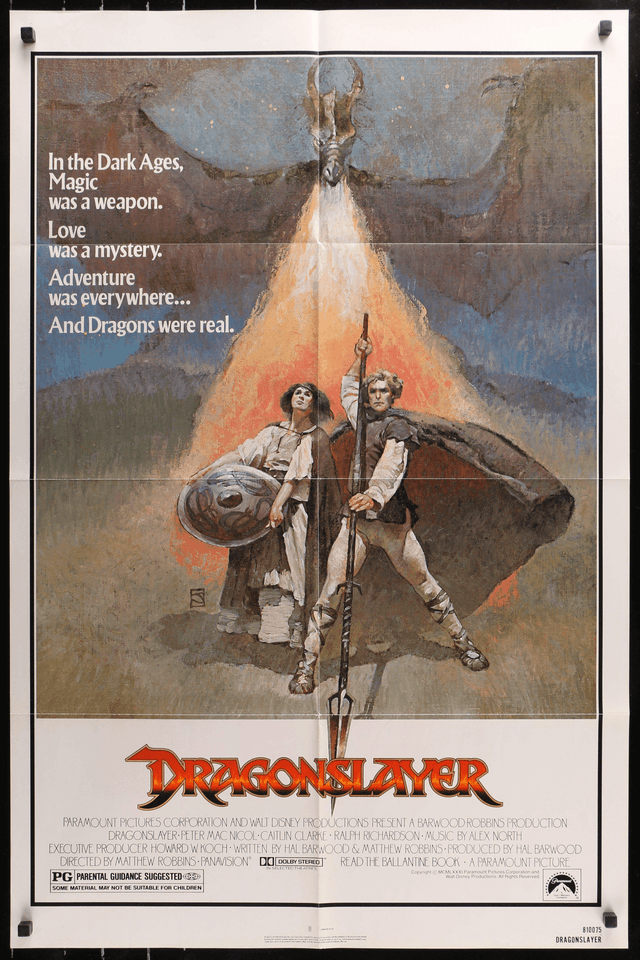
Dragonslayer (1981)
Synopsis
"Dragonslayer" (1981) is a fantasy adventure film that transports viewers to a mythical medieval world where the existence of dragons poses a dire threat to humanity. The story follows a young apprentice named Galen, who is trained in the ancient arts of sorcery by the wise and aging wizard, Ulrich. When a fearsome dragon named Vermithrax Pejorative begins to terrorize a nearby kingdom, demanding sacrifices of young maidens, Galen must rise to the challenge.
As he embarks on a perilous quest to confront the beast, Galen discovers the true nature of courage and the complexities of magic. Alongside a brave princess and a band of loyal allies, he navigates treacherous landscapes and faces formidable foes. The film masterfully blends elements of adventure, romance, and suspense, culminating in an epic showdown between good and evil. With groundbreaking special effects for its time, "Dragonslayer" remains a captivating tale of heroism and the battle against darkness.
What is the budget of Dragonslayer?
"Dragonslayer," released in 1981, is a fantasy adventure film directed by Matthew Robbins. The movie features notable performances from actors such as Peter MacNicol, Caitlin Clarke, and Ralph Richardson. This captivating tale of heroism and magic has intrigued audiences for decades, but what about its financial aspects? Understanding the budget of "Dragonslayer" provides insight into its production scale and the challenges faced during its making.
What was the production budget?
The production budget for "Dragonslayer" was set at $18,000,000. This figure places it within a significant range for fantasy films of its time. When compared to other movies in the genre, such as "Excalibur" (1981) with a budget of around $11 million, "Dragonslayer" had a more substantial financial backing, allowing for ambitious special effects and elaborate set designs.
Key Budget Allocation Categories
While specific breakdowns of budget allocation are not widely available, major cost factors typically include:
- Special Effects: A significant portion of the budget was likely dedicated to the groundbreaking special effects that brought the dragon to life.
- Locations: Filming in various locations to create the medieval atmosphere would have contributed to overall costs.
- Talent: The salaries of the cast and crew, including the experienced Ralph Richardson, would have also impacted the budget.
What were the major production costs?
Several elements contributed to the overall production costs of "Dragonslayer." The film's special effects, particularly the dragon, were a major expense. The team utilized innovative techniques for the time, which required skilled artists and advanced technology.
Notable scenes, such as the climactic battle with the dragon, demanded extensive resources and planning. Budget challenges arose, as the initial budget of $18 million may have faced overruns due to the ambitious nature of the project and the need for high-quality visual effects.
How did the box office perform?
"Dragonslayer" earned approximately $6,000,000 at the domestic box office. This figure highlights a significant gap between production costs and earnings, raising questions about its financial success.
Domestic vs. International Breakdown
While specific international earnings are not detailed, the domestic performance indicates that the film struggled to recoup its production costs. The break-even point for a film of this budget typically requires earnings of about $36 million when considering marketing and distribution costs.
ROI Percentage
Given the production budget and box office earnings, the return on investment (ROI) for "Dragonslayer" is notably low. With a budget of $18 million and earnings of $6 million, the film did not achieve profitability.
Was the movie profitable?
"Dragonslayer" did not turn a profit, as its box office earnings fell significantly short of its production costs. The financial impact on the studio was considerable, leading to a reevaluation of budgets for future fantasy films.
How did it affect the studio/franchise?
The underperformance of "Dragonslayer" likely influenced the studio's approach to financing similar projects in the future. It served as a cautionary tale regarding the risks associated with high-budget fantasy films during that era.
Impact on future movie budgets in the genre
The financial results of "Dragonslayer" may have led studios to adopt more conservative budgets for subsequent fantasy films. This shift could be seen in later productions that aimed for a balance between ambition and financial viability.
Commonly Asked Questions
How much did Dragonslayer (1981) cost to make?
The production cost of "Dragonslayer" was $18,000,000.
Was Dragonslayer (1981) profitable?
No, "Dragonslayer" was not profitable, earning only $6,000,000 at the box office.
What was the most expensive element of Dragonslayer (1981)?
The most expensive element was likely the special effects used to create the dragon, which were groundbreaking for the time.
How much did Dragonslayer (1981) make at the box office?
The film made approximately $6,000,000 at the domestic box office.
Did Dragonslayer (1981) go over budget?
While specific details on budget overruns are not available, the ambitious nature of the project suggests that it may have faced challenges in staying within the initial budget of $18 million.
Understanding the budget and financial performance of "Dragonslayer" provides valuable insights into the challenges faced by filmmakers in the fantasy genre during the early 1980s. Despite its artistic merits, the film's financial struggles highlight the complexities of producing high-budget cinematic experiences.

































Budget Templates
Build your own production budget
Create professional budgets with AICP and feature film templates. Real-time collaboration, no spreadsheets.
Start Budgeting Free
.png&w=1200&q=75)