
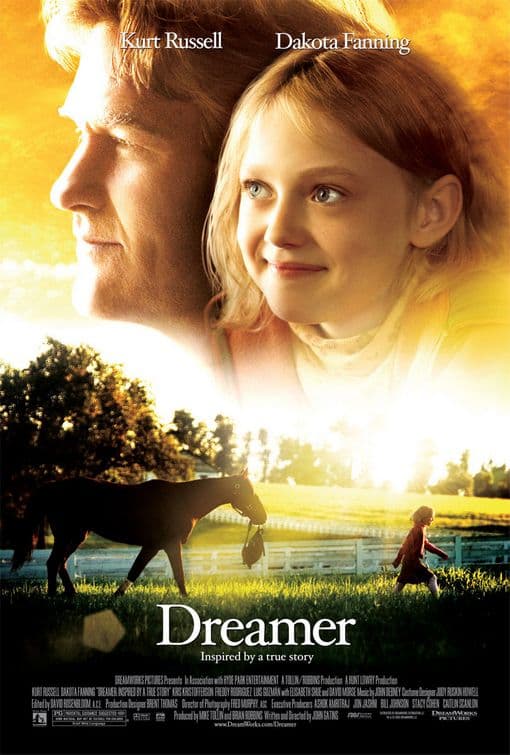
Dreamer: Inspired by a True Story
Synopsis
Ben Crane is a horse trainer who is struggling to connect with his precocious daughter, Cale. But then a horse by the name of Soñador suffers a broken leg after its evil owner races her despite Ben’s advice. Rather than put his client’s injured horse down, Ben adopts her and welcomes Cale into the family business. They train Soñador to race again as grouchy but kind-hearted Grandpa lends his encouragement.
What is the budget of Dreamer: Inspired by a True Story?
Dreamer: Inspired by a True Story, directed by John Gatins, features a heartwarming narrative centered around the bond between a father and daughter, played by Kurt Russell and Dakota Fanning. Released on December 22, 2005, this film captures the essence of perseverance and family through the story of a horse trainer and an injured racehorse. The budget of this film plays a significant role in understanding its production and financial journey.
What was the production budget?
The production budget for Dreamer: Inspired by a True Story was $32,000,000. This figure places it within a moderate range for family-oriented dramas, especially those involving sports themes. Compared to similar films in the genre, such as Seabiscuit, which had a budget of approximately $87 million, Dreamer’s budget reflects a more restrained financial approach.
Key Budget Allocation Categories
While specific breakdowns of budget allocation are not publicly available, typical costs for films like Dreamer often include:
- Talent: Salaries for the lead actors and supporting cast.
- Locations: Expenses related to filming in various settings, including stables and racetracks.
- Production Design: Costs associated with creating the film's visual aesthetic.
What were the major production costs?
Several factors contributed to the overall production costs of Dreamer: Inspired by a True Story.
- Talent: The film featured well-known actors, which likely accounted for a significant portion of the budget.
- Locations: Filming on location can be expensive, especially when capturing the essence of horse racing.
- Training Horses: The film required extensive training for the horses, adding to the production costs.
Notable scenes, such as the training montages and race sequences, likely required additional resources, including specialized equipment and safety measures for the horses and actors.
How did the box office perform?
Dreamer: Inspired by a True Story earned a worldwide box office total of $39,498,360. The domestic box office earnings reached $33,022,286, indicating a solid performance in the U.S. market.
Break-even Point Analysis
To determine the break-even point, one must consider the production budget and marketing costs. Assuming marketing expenses were around 50% of the production budget, the estimated break-even point would be approximately $48 million. With total earnings of $39.5 million, the film fell short of this target.
ROI Percentage
Calculating the return on investment (ROI) reveals that the film did not achieve profitability. The ROI can be calculated as follows:
- Total Earnings: $39,498,360
- Production Budget: $32,000,000
- ROI: \[(Total Earnings - Production Budget) / Production Budget\] x 100 = \[(39,498,360 - 32,000,000) / 32,000,000\] x 100 = 23.4%
Was the movie profitable?
Despite its heartwarming story and solid performances, Dreamer: Inspired by a True Story did not turn a profit. The film's earnings fell short of the estimated break-even point, which impacted its financial success.
How did it affect the studio/franchise?
The financial performance of Dreamer may have influenced DreamWorks Pictures' approach to future family-oriented films. While it did not set any records, the film contributed to the studio's portfolio of family dramas, showcasing the importance of storytelling over box office numbers.
Impact on future movie budgets in the genre
The film's budget and performance may have led studios to reassess their financial strategies for similar projects. A more cautious approach could emerge, focusing on balancing production costs with expected box office returns.
Commonly Asked Questions
How much did Dreamer: Inspired by a True Story cost to make?
The production cost of Dreamer: Inspired by a True Story was $32,000,000.
Was Dreamer: Inspired by a True Story profitable?
No, the film did not achieve profitability, as its earnings fell short of the estimated break-even point.
What was the most expensive element of Dreamer: Inspired by a True Story?
While specific details are not available, the most expensive elements likely included talent salaries and location costs.
How much did Dreamer: Inspired by a True Story make at the box office?
The film earned a total of $39,498,360 worldwide.
Did Dreamer: Inspired by a True Story go over budget?
There is no public information indicating that Dreamer went over budget, as it was produced within the $32 million range.
In summary, Dreamer: Inspired by a True Story serves as an interesting case study in film budgeting and box office performance. While it delivered a touching narrative, its financial outcomes highlight the challenges faced by family dramas in a competitive market.

































Budget Templates
Build your own production budget
Create professional budgets with AICP and feature film templates. Real-time collaboration, no spreadsheets.
Start Budgeting Free
.png&w=1200&q=75)