
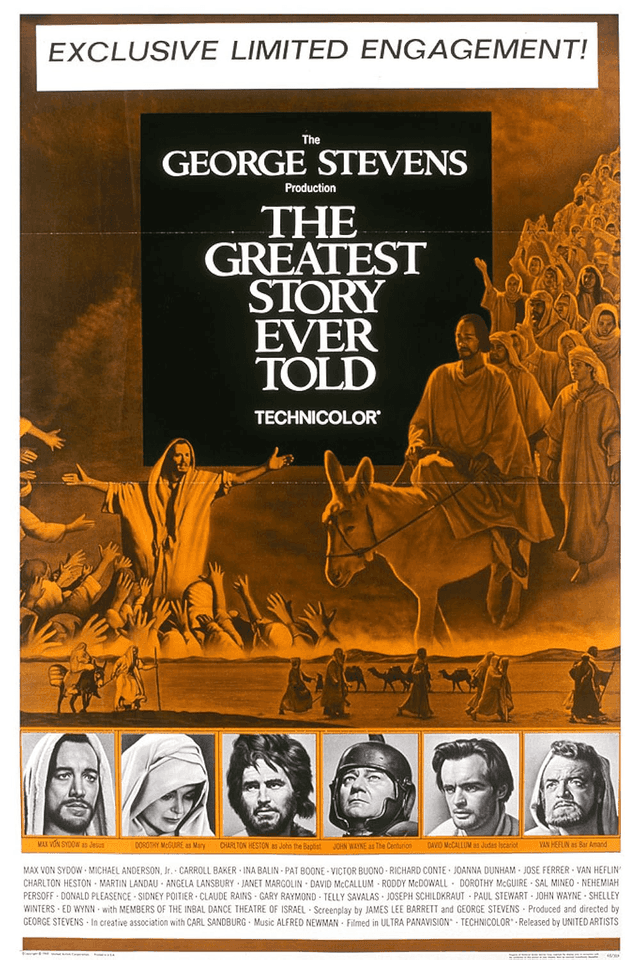
The Greatest Story Ever Told (1965)
Synopsis
"The Greatest Story Ever Told" (1965) is an epic retelling of the life of Jesus Christ, showcasing his journey from humble beginnings to his profound impact on humanity. The film begins with the Nativity, depicting the birth of Jesus in Bethlehem, and follows his life through key events such as his baptism by John the Baptist, the gathering of his disciples, and the performance of miracles.
As the narrative unfolds, viewers witness the teachings of Jesus, emphasizing love, compassion, and forgiveness. The film also explores the political and social tensions of the time, highlighting the opposition he faced from religious leaders and the Roman authorities.
Culminating in the Passion, the story portrays the betrayal, trial, crucifixion, and resurrection of Christ, ultimately conveying a message of hope and redemption. With a star-studded cast and grand cinematography, "The Greatest Story Ever Told" aims to inspire audiences with its portrayal of one of history's most significant figures.
What is the budget of The Greatest Story Ever Told?
An interesting fact about "The Greatest Story Ever Told" (1965) is that it was one of the most ambitious biblical epics of its time, aiming to portray the life of Jesus Christ with grandeur and depth. Directed by George Stevens, the film features a star-studded cast, including Max von Sydow, Dorothy McGuire, and Charlton Heston. Released on February 15, 1965, this cinematic endeavor had a significant budget that reflects its scale and aspirations.
The budget of "The Greatest Story Ever Told" is noteworthy, especially when considering its box office performance and the impact it had on future biblical films.
Budget Overview
The production budget for "The Greatest Story Ever Told" was a staggering $20,000,000. This figure places it among the higher-budget films of its era, particularly within the biblical epic genre. For comparison, films like "Ben-Hur" (1959) had a budget of around $15 million, while "The Ten Commandments" (1956) was produced for approximately $13 million.
While specific budget allocation details are not widely available, it is clear that significant funds were directed towards elaborate sets, costumes, and a large ensemble cast, all of which contributed to the film's epic scale.
What were the major production costs?
Several factors contributed to the overall production costs of "The Greatest Story Ever Told." Key elements included:
- Location Filming: Extensive on-location shooting in various countries added to the expenses.
- Special Effects: The film employed practical effects to depict miracles and other significant events.
- Talent: The involvement of high-profile actors and a renowned director naturally increased the budget.
Notable scenes, such as the crucifixion and resurrection, required elaborate setups and special effects, which likely contributed to budget challenges. While the initial budget was set at $20 million, the final costs may have exceeded this figure due to unforeseen expenses.
How did the film perform at the box office?
The worldwide box office earnings for "The Greatest Story Ever Told" reached approximately $15,473,333.00. This figure highlights a significant gap between the production budget and the box office returns.
- Domestic vs. International Breakdown: The film's domestic earnings were notably lower than its budget, raising questions about its financial viability.
- Break-even Point Analysis: To break even, the film would have needed to earn around $40 million, considering marketing and distribution costs.
- ROI Percentage: With a return of approximately 77% of its budget, the film did not achieve profitability.
Was the movie profitable?
Given the box office performance, "The Greatest Story Ever Told" was not profitable. The financial losses impacted the studio's future projects and set a precedent for how biblical epics were financed and produced.
The film's underperformance also influenced subsequent movie budgets in the genre, leading studios to be more cautious with their investments in similar projects.
Commonly Asked Questions
How much did The Greatest Story Ever Told (1965) cost to make?
The production cost of "The Greatest Story Ever Told" was $20,000,000.
Was The Greatest Story Ever Told (1965) profitable?
No, the film was not profitable, earning approximately $15,473,333 at the box office.
What was the most expensive element of The Greatest Story Ever Told (1965)?
While specific details are scarce, significant costs likely stemmed from location filming and the large ensemble cast.
How much did The Greatest Story Ever Told (1965) make at the box office?
The film made approximately $15,473,333 at the box office.
Did The Greatest Story Ever Told (1965) go over budget?
While the initial budget was $20 million, it is suggested that final costs may have exceeded this amount due to various production challenges.
In summary, "The Greatest Story Ever Told" stands as a significant example of the challenges faced by high-budget films in the biblical genre. Its ambitious scope and notable cast did not translate into financial success, serving as a cautionary tale for future productions.
































Budget Templates
Build your own production budget
Create professional budgets with industry-standard feature film templates. Real-time collaboration, no spreadsheets.
Start Budgeting Free
.png&w=1200&q=75)