
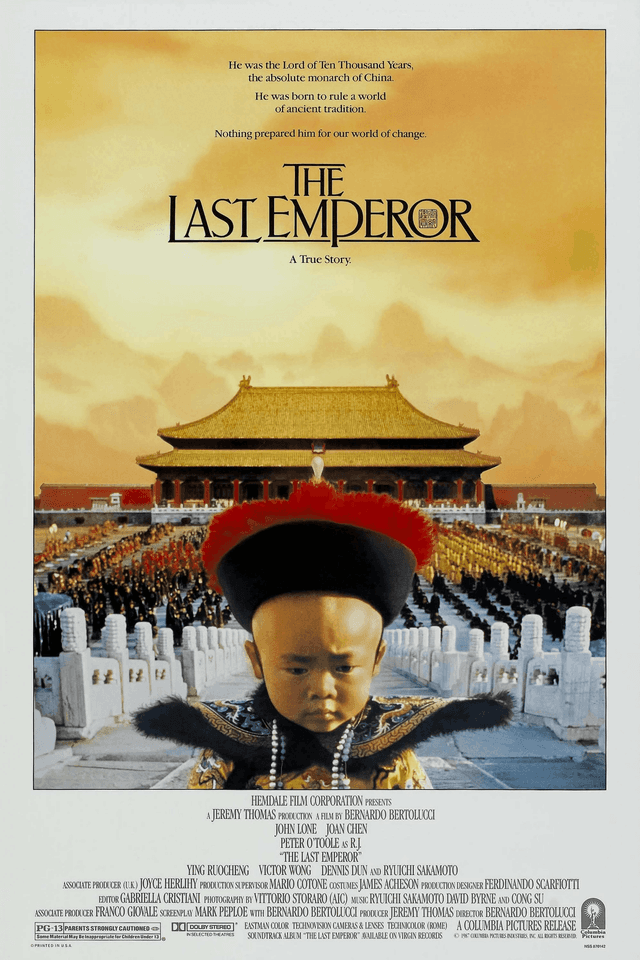
The Last Emperor
Synopsis
"The Last Emperor" is a sweeping historical drama that chronicles the life of Puyi, the last Emperor of China, who ascended to the throne as a child and experienced the tumultuous changes of the 20th century. Born into the opulence of the Forbidden City, Puyi's reign is marked by political upheaval, foreign invasions, and personal tragedy. As he navigates the complexities of his position, the film explores themes of power, identity, and the impact of history on individual lives. Following his abdication, Puyi's journey takes him from the heights of imperial privilege to the depths of a reformed citizen, ultimately reflecting on the loss of a dynasty and the struggle for self-discovery in a rapidly changing world. The film is a poignant portrayal of a man caught between tradition and modernity, showcasing the rich tapestry of Chinese history through his eyes.
What is the budget of The Last Emperor?
"The Last Emperor," directed by Bernardo Bertolucci, is a historical drama that captivates audiences with its rich storytelling and stunning visuals. Released in 1987, the film features a remarkable cast, including John Lone, Joan Chen, and Peter O'Toole. The movie's budget plays a significant role in understanding its production and financial success, making it a fascinating case study in the film industry.
What was the production budget of The Last Emperor?
The production budget for "The Last Emperor" was set at $25,000,000. This figure places it within a competitive range when compared to other historical dramas of its time, which often required substantial financial backing to recreate elaborate settings and costumes. For instance, films like "Gandhi" and "The English Patient" also had similar budget allocations, highlighting the financial commitment needed for epic storytelling.
Key Budget Allocation Categories
While specific breakdowns of budget categories for "The Last Emperor" are not widely available, major cost factors typically include:
- Location Filming: Extensive shooting in China, particularly in the Forbidden City, added to the overall costs.
- Costumes and Set Design: Authentic period costumes and detailed set designs were crucial for historical accuracy.
- Talent: The involvement of renowned actors and a skilled production team contributed to the budget.
What were the major production costs?
Several elements significantly impacted the production costs of "The Last Emperor." Notable expenses included:
- Location Costs: Filming in historically significant locations required permits and logistical planning.
- Special Effects: While not heavily reliant on CGI, practical effects and set pieces were essential for creating the film's immersive experience.
- Talent Fees: The film's star-studded cast commanded high salaries, reflecting their market value.
Challenges arose during production, particularly with location logistics and the need for authenticity, which sometimes led to budget overruns. The initial budget of $25 million was closely monitored, but the final costs may have exceeded this figure due to unforeseen expenses.
How did The Last Emperor perform at the box office?
"The Last Emperor" achieved impressive box office earnings, grossing $44,005,435 worldwide. The domestic box office alone accounted for $43,984,987, showcasing its strong performance in the United States.
Break-even Point Analysis
To determine the break-even point, one must consider the production budget and marketing costs. Typically, a film needs to earn approximately double its production budget to cover all expenses. In this case, "The Last Emperor" surpassed its break-even point, indicating a successful financial outcome.
ROI Percentage
The return on investment (ROI) for "The Last Emperor" can be calculated as follows:
- Total Earnings: $44,005,435
- Production Budget: $25,000,000
- ROI: \[(Total Earnings - Production Budget) / Production Budget\] x 100 = \[(44,005,435 - 25,000,000) / 25,000,000\] x 100 = 76.02%
This ROI percentage reflects a solid financial return for the film.
Was The Last Emperor profitable?
Yes, "The Last Emperor" was profitable. The film not only recouped its production costs but also generated a significant profit, contributing positively to the financial standing of Columbia Pictures and its partners.
Impact on the Studio and Future Budgets
The success of "The Last Emperor" influenced future projects within the historical drama genre, encouraging studios to invest in similar epic narratives. The film set a precedent for high-quality productions that could achieve both critical acclaim and box office success.
Records Set
While "The Last Emperor" may not have set specific box office records, it did win nine Academy Awards, including Best Picture, which solidified its status as a landmark film in cinema history.
Commonly Asked Questions
How much did The Last Emperor cost to make?
The production cost of "The Last Emperor" was $25,000,000.
Was The Last Emperor profitable?
Yes, the film was profitable, earning over $44 million at the box office.
What was the most expensive element of The Last Emperor?
While specific figures are not disclosed, location filming and talent fees were likely among the most significant expenses.
How much did The Last Emperor make at the box office?
The film grossed $44,005,435 worldwide.
Did The Last Emperor go over budget?
There are indications that the final costs may have exceeded the initial budget of $25 million due to various production challenges.
In summary, "The Last Emperor" stands as a testament to the potential financial success of well-crafted historical dramas. Its budget, box office performance, and overall impact on the film industry highlight the importance of strategic investment in storytelling.

































Budget Templates
Build your own production budget
Create professional budgets with AICP and feature film templates. Real-time collaboration, no spreadsheets.
Start Budgeting Free
.png&w=1200&q=75)