
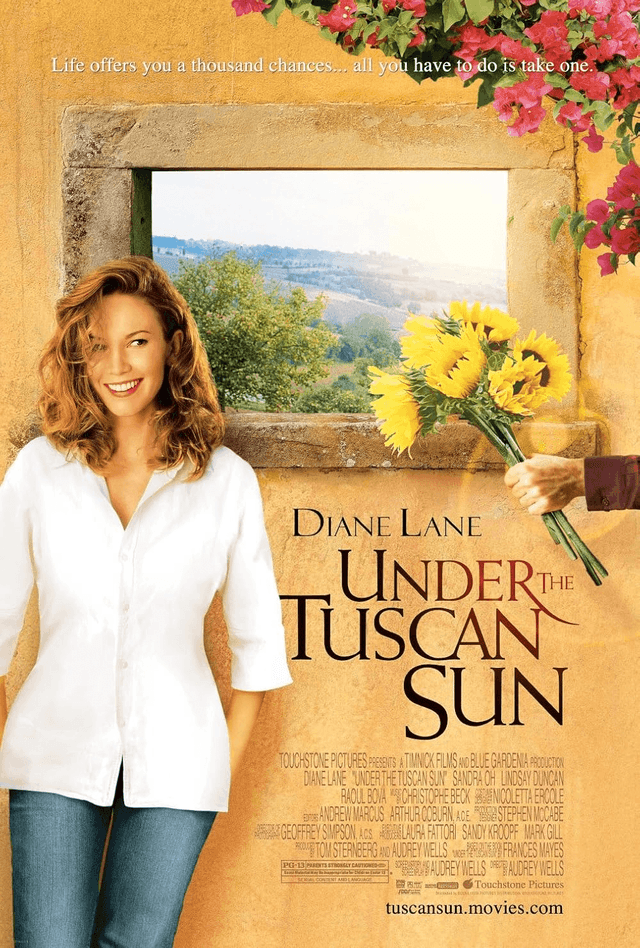
Under the Tuscan Sun (2003)
Synopsis
"Under the Tuscan Sun" (2003) follows the journey of Frances Mayes, a successful but recently divorced writer played by Diane Lane. Seeking a fresh start, she embarks on a spontaneous trip to Italy, where she discovers a dilapidated villa in the picturesque Tuscan countryside. Captivated by its charm, Frances decides to purchase the property, hoping to transform it into a beautiful home. As she navigates the challenges of renovation, she also encounters a vibrant cast of locals and fellow expatriates who help her rediscover joy, love, and the beauty of life. Through her experiences, Frances learns to embrace change and the unexpected, ultimately finding a sense of belonging and purpose in her new Italian life.
What is the budget of Under the Tuscan Sun?
"Under the Tuscan Sun," released in 2003, is a romantic drama directed by Audrey Wells. The film stars Diane Lane as Frances Mayes, a recently divorced writer who seeks a new beginning in Italy. This charming story not only captivated audiences but also raised questions about its financial aspects, particularly its budget and box office performance.
What was the production budget?
The production budget for "Under the Tuscan Sun" was set at $18,000,000. This figure places it within a moderate range for romantic dramas of its time. For comparison, films like "The Holiday" (2006) had a budget of around $85 million, while "Eat Pray Love" (2010) was produced for approximately $60 million. The budget for "Under the Tuscan Sun" reflects a more intimate scale, focusing on character-driven storytelling rather than high-octane action or special effects.
Key Budget Allocation Categories
While specific breakdowns of budget allocation are not publicly available, typical costs for films in this genre often include:
- Location Expenses: Filming in picturesque Tuscany likely contributed significantly to the budget.
- Talent Costs: Diane Lane, as the lead, would have commanded a substantial salary.
- Production Design: Renovating the villa and creating the film's aesthetic would have required a notable investment.
What were the major cost factors?
Several elements contributed to the overall production costs of "Under the Tuscan Sun."
- Location: The stunning Tuscan landscape not only served as a backdrop but also required careful planning and logistics.
- Cast Salaries: Diane Lane's performance was pivotal, and her compensation would have been a significant portion of the budget.
- Set Design: The transformation of the villa was a key visual element, necessitating investment in set design and construction.
Challenges did arise during production, particularly in managing costs associated with location shoots and set renovations. However, the film remained within its initial budget, avoiding major overruns.
How did the film perform at the box office?
"Under the Tuscan Sun" achieved impressive box office results, grossing $57,490,024 worldwide. The domestic box office earnings amounted to $43,601,508, showcasing its appeal primarily in the United States.
Break-even Point Analysis
To determine the break-even point, one must consider the production budget and marketing costs. Typically, a film needs to earn about double its production budget to cover all expenses. In this case, "Under the Tuscan Sun" surpassed that threshold, indicating a successful financial performance.
ROI Percentage
The return on investment (ROI) for "Under the Tuscan Sun" can be calculated as follows:
- Total Earnings: $57,490,024
- Production Budget: $18,000,000
- ROI: \[(Total Earnings - Production Budget) / Production Budget\] x 100
- ROI Calculation: \[(57,490,024 - 18,000,000) / 18,000,000\] x 100 = 219.39%
This impressive ROI highlights the film's financial success.
Was the movie profitable?
Yes, "Under the Tuscan Sun" was profitable. The film not only recouped its production costs but also generated significant earnings, contributing positively to the studio's financial standing. Its success likely influenced future projects within the romantic drama genre, encouraging studios to invest in similar character-driven narratives.
Impact on Future Movie Budgets
The financial success of "Under the Tuscan Sun" may have set a precedent for studios to allocate budgets for films that prioritize storytelling and character development over extravagant special effects. This trend can be seen in subsequent romantic dramas that followed a similar formula.
Commonly Asked Questions
How much did Under the Tuscan Sun (2003) cost to make?
The production cost of "Under the Tuscan Sun" was $18,000,000.
Was Under the Tuscan Sun (2003) profitable?
Yes, the film was profitable, earning over $57 million at the box office.
What was the most expensive element of Under the Tuscan Sun (2003)?
While specific figures are not disclosed, location expenses and cast salaries were likely among the most significant costs.
How much did Under the Tuscan Sun (2003) make at the box office?
The film grossed $57,490,024 worldwide.
Did Under the Tuscan Sun (2003) go over budget?
No, the film remained within its initial budget of $18,000,000.
In summary, "Under the Tuscan Sun" stands as a testament to the potential for financial success in the romantic drama genre, with its budget and box office performance reflecting a well-executed production that resonated with audiences.































Budget Templates
Build your own production budget
Create professional budgets with AICP and feature film templates. Real-time collaboration, no spreadsheets.
Start Budgeting Free