
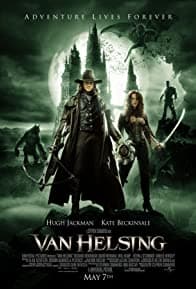
Van Helsing (2004)
Synopsis
"Van Helsing" (2004) is an action-packed adventure that reimagines the classic monster hunter from Bram Stoker's "Dracula." Set in the late 19th century, the film follows Gabriel Van Helsing, portrayed by Hugh Jackman, a legendary monster hunter working for a secret organization dedicated to eradicating evil. Tasked with defeating Count Dracula, played by Richard Roxburgh, Van Helsing travels to Transylvania, where he encounters a host of supernatural creatures, including werewolves and Frankenstein's monster.
As Van Helsing teams up with Anna Valerious, a fierce warrior from a family cursed by Dracula, they embark on a perilous journey to confront the vampire lord and save her family’s legacy. The film is filled with thrilling action sequences, stunning visual effects, and a blend of horror and humor, making it a unique take on the classic horror genre. With its gothic atmosphere and a storyline that intertwines various legendary monsters, "Van Helsing" delivers an exhilarating cinematic experience that keeps audiences on the edge of their seats.
What is the budget of Van Helsing?
"Van Helsing" (2004) stands out as a thrilling reimagining of the classic monster hunter from Bram Stoker's "Dracula." Directed by Stephen Sommers, the film features a star-studded cast, including Hugh Jackman as Gabriel Van Helsing and Richard Roxburgh as Count Dracula. Released on May 7, 2004, this action-packed adventure not only captivated audiences but also raised questions about its substantial budget and financial performance.
The budget of "Van Helsing" is particularly significant, as it reflects the ambitious scope of the film and its attempt to blend various horror elements into a cohesive narrative.
What was the production budget?
The production budget for "Van Helsing" was a staggering $170,000,000. This figure places it among the higher echelons of film budgets, especially for its time. When compared to similar films in the action-horror genre, "Van Helsing" stands out. For instance, films like "The Mummy Returns" (2001) had a budget of around $100 million, while "Underworld" (2003) was produced for approximately $22 million. The significant investment in "Van Helsing" aimed to deliver high-quality special effects and elaborate set designs.
Key Budget Allocation Categories
While specific breakdowns of budget allocation are not publicly available, major cost factors likely included:
- Special Effects: Given the film's reliance on CGI and practical effects to bring monsters to life.
- Locations: Filming in various locations, including the Czech Republic, added to the overall costs.
- Talent: The salaries of high-profile actors and a skilled production team contributed significantly to the budget.
What were the major production costs?
Several elements contributed to the high production costs of "Van Helsing." Notable expenses included:
- Special Effects: The film featured extensive CGI, particularly in scenes involving werewolves and Dracula's transformations.
- Set Design: Creating the gothic atmosphere required elaborate sets and locations, which were both time-consuming and costly.
- Stunt Coordination: The action sequences demanded skilled stunt performers and choreographers, further inflating the budget.
Despite the initial budget of $170 million, the final costs may have exceeded expectations due to the ambitious nature of the project and the challenges faced during production.
How did Van Helsing perform at the box office?
"Van Helsing" achieved worldwide box office earnings of $300,150,546. This impressive figure includes a domestic box office total of $120,150,546.
Break-even Point Analysis
To determine the break-even point, a film typically needs to earn about twice its production budget to cover marketing and distribution costs. In this case, "Van Helsing" would have needed to gross approximately $340 million to break even. While it fell short of this target, it still generated a substantial return.
ROI Percentage
Calculating the return on investment (ROI) for "Van Helsing" involves comparing its earnings to its production costs. With a budget of $170 million and earnings of $300 million, the ROI can be calculated as follows:
- ROI = (Earnings - Budget) / Budget x 100
- ROI = ($300,150,546 - $170,000,000) / $170,000,000 x 100 ≈ 76.6%
Was Van Helsing profitable?
Despite not reaching its break-even point, "Van Helsing" can be considered moderately profitable, with an ROI of approximately 76.6%. The film's financial performance had implications for the studio, Universal Pictures, as it influenced future projects and budget allocations within the action-horror genre.
Impact on Future Movie Budgets
The mixed financial success of "Van Helsing" prompted studios to reassess their investment strategies in similar genres. While high-budget films continued to be produced, there was a noticeable shift towards more cautious spending, especially for projects involving special effects and large ensemble casts.
Records Set
While "Van Helsing" did not set any major box office records, its budget and production scale were noteworthy for the time, reflecting the growing trend of blockbuster films investing heavily in visual effects and star power.
Commonly Asked Questions
How much did Van Helsing (2004) cost to make?
The production cost of "Van Helsing" was $170,000,000.
Was Van Helsing (2004) profitable?
Yes, "Van Helsing" was moderately profitable, with an ROI of approximately 76.6%.
What was the most expensive element of Van Helsing (2004)?
The most expensive elements likely included special effects and set design, which were crucial for creating the film's gothic atmosphere.
How much did Van Helsing (2004) make at the box office?
"Van Helsing" grossed $300,150,546 worldwide.
Did Van Helsing (2004) go over budget?
While the initial budget was $170 million, it is possible that final costs exceeded this figure due to the ambitious nature of the project.
In summary, "Van Helsing" serves as a fascinating case study in film budgeting and box office performance. Its substantial budget and mixed financial results highlight the risks and rewards associated with high-stakes filmmaking in the action-horror genre.
































Budget Templates
Build your own production budget
Create professional budgets with AICP and feature film templates. Real-time collaboration, no spreadsheets.
Start Budgeting Free