
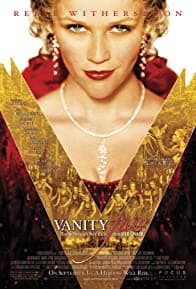
Vanity Fair (2004)
Synopsis
"Vanity Fair" (2004) is a vibrant adaptation of William Makepeace Thackeray's classic novel, set against the backdrop of early 19th-century England. The story follows the ambitious and cunning Becky Sharp, portrayed by Reese Witherspoon, as she navigates the complexities of high society. Orphaned and determined to rise above her humble beginnings, Becky employs her wit and charm to manipulate those around her, forging relationships with the wealthy and powerful.
As she climbs the social ladder, Becky encounters a colorful cast of characters, including her loyal friend Amelia Sedley, played by Romola Garai, and the dashing but unreliable George Osborne, portrayed by James Purefoy. The film explores themes of ambition, betrayal, and the pursuit of wealth, all while showcasing the opulence and moral ambiguities of the era. With stunning visuals and a captivating performance by Witherspoon, "Vanity Fair" offers a rich tapestry of love, loss, and the relentless quest for status in a world driven by vanity.
What is the budget of Vanity Fair?
"Vanity Fair" (2004) is a captivating adaptation of William Makepeace Thackeray's classic novel, directed by Mira Nair. The film features a stellar cast, including Reese Witherspoon in the lead role as the ambitious Becky Sharp, alongside Romola Garai and James Purefoy. Released on September 29, 2004, this film not only brings to life the opulence of early 19th-century England but also raises questions about its financial performance. Understanding the budget of "Vanity Fair" is crucial for grasping its box office impact and overall success.
Budget Overview
The production budget for "Vanity Fair" was set at $23,000,000. When compared to other films in the period drama genre, this budget falls within a typical range. For instance, films like "Pride & Prejudice" (2005) had a similar budget, while others, such as "Atonement" (2007), operated with a higher financial backing.
While specific budget allocation details are not publicly available, it is common for period dramas to allocate significant funds towards set design, costumes, and location shoots to authentically recreate the historical setting.
What were the major production costs?
Several factors contributed to the overall production costs of "Vanity Fair." Key elements included:
- Costumes and Set Design: Authentic period costumes and elaborate sets are essential for immersing the audience in the era.
- Location Filming: Shooting in various locations across England added to the logistical expenses.
- Talent: The cast, particularly Witherspoon, likely commanded a substantial portion of the budget.
Noteworthy scenes that may have incurred higher costs include lavish ball sequences and intricate outdoor settings. While the film aimed to stay within its budget, challenges such as location changes or unexpected production delays could have led to budget overruns.
How did Vanity Fair perform at the box office?
"Vanity Fair" grossed a total of $19,123,851 worldwide, with domestic earnings accounting for $16,123,851. To determine the break-even point, one must consider the production budget alongside marketing costs, which can often double the initial budget. Given the film's earnings, it did not reach the break-even point, indicating a financial shortfall.
The return on investment (ROI) for "Vanity Fair" can be calculated as follows:
- ROI = (Total Earnings - Production Cost) / Production Cost x 100
- ROI = ($19,123,851 - $23,000,000) / $23,000,000 x 100 = -17.3%
This negative ROI suggests that the film did not achieve financial success.
Was Vanity Fair profitable?
The financial outcome of "Vanity Fair" indicates that it was not profitable. The film's box office earnings fell short of its production costs, leading to a loss for the studio. This outcome may have influenced future projects by Focus Features and other studios in the genre, prompting them to reassess budget allocations and marketing strategies for period dramas.
While "Vanity Fair" did not set any notable records, its performance serves as a reminder of the risks associated with adapting classic literature into film.
Commonly Asked Questions
How much did Vanity Fair (2004) cost to make?
The production cost of "Vanity Fair" was $23,000,000.
Was Vanity Fair (2004) profitable?
No, "Vanity Fair" was not profitable, as its box office earnings did not cover its production costs.
What was the most expensive element of Vanity Fair (2004)?
While specific figures are not disclosed, significant costs likely stemmed from costumes and set design, essential for the film's period authenticity.
How much did Vanity Fair (2004) make at the box office?
The film grossed $19,123,851 worldwide.
Did Vanity Fair (2004) go over budget?
The film's final costs exceeded its initial budget of $23,000,000, contributing to its financial challenges.
In summary, "Vanity Fair" serves as an intriguing case study in film budgeting and box office performance. Despite its rich storytelling and visual appeal, the film's financial results highlight the complexities of producing period dramas in a competitive market.






























Budget Templates
Build your own production budget
Create professional budgets with AICP and feature film templates. Real-time collaboration, no spreadsheets.
Start Budgeting Free