
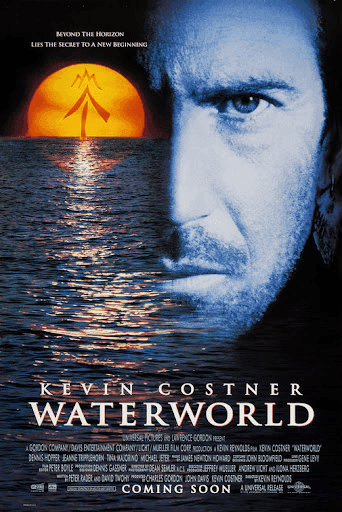
Waterworld (1995)
Synopsis
"Waterworld," released in 1995, is a post-apocalyptic science fiction film set in a future where the polar ice caps have melted, submerging most of the Earth's landmass. The story follows a lone drifter known as the Mariner, played by Kevin Costner, who navigates the vast ocean on a makeshift trimaran. In this waterlogged world, he encounters a group of survivors led by a woman named Helen, who possesses a map to the mythical Dryland, the last remaining piece of land.
As the Mariner becomes embroiled in a conflict with the villainous Smokers, a gang of pirates who seek to control the seas and capture Helen for her knowledge, he must protect her and the young girl, Enola, who bears a tattoo that may lead them to Dryland. The film explores themes of survival, environmental degradation, and the quest for hope in a seemingly hopeless world. With its ambitious set pieces and groundbreaking special effects, "Waterworld" remains a notable entry in the realm of sci-fi cinema.
What is the budget of Waterworld?
"Waterworld," a film that has sparked discussions since its release, was directed by Kevin Reynolds and features notable performances from Kevin Costner, Jeanne Tripplehorn, and Dennis Hopper. Released in 1995, this post-apocalyptic science fiction adventure is remembered not only for its ambitious storytelling but also for its staggering budget, which has become a significant talking point in film history.
What was the production budget of Waterworld?
The production budget for "Waterworld" was a staggering $175 million. This figure places it among the most expensive films ever made at the time of its release. When compared to other films in the science fiction genre, such as "The Fifth Element" (1997) with a budget of around $90 million, "Waterworld" stands out for its financial scale. The film's budget was primarily allocated to special effects, set construction, and talent, reflecting the ambitious vision of its creators.
What were the major cost factors in Waterworld's production?
Several key factors contributed to the high production costs of "Waterworld":
- Special Effects: The film featured extensive water-based stunts and visual effects, which required advanced technology and skilled professionals.
- Set Construction: Building the massive floating sets and the trimaran used by the Mariner was a significant expense.
- Talent: The star power of Kevin Costner, who was one of Hollywood's biggest names at the time, added to the overall budget.
Notable scenes, such as the climactic battles and the construction of the floating atoll, were particularly costly. The film faced budget challenges, with initial estimates being lower than the final costs, leading to some financial strain during production.
How did Waterworld perform at the box office?
"Waterworld" grossed approximately $264.2 million worldwide, with $88.2 million coming from the domestic box office. To break even, the film needed to earn around $350 million, which means it fell short of this target. The return on investment (ROI) percentage was not favorable, as the film did not recoup its production and marketing costs.
Was Waterworld profitable?
Despite its impressive box office earnings, "Waterworld" was not considered profitable. The film's financial performance had a lasting impact on Universal Pictures, leading to a more cautious approach to big-budget productions in the future. The film's struggles also influenced how studios approached budgets for similar genre films, often resulting in lower initial budgets for subsequent projects.
Commonly Asked Questions
How much did Waterworld (1995) cost to make?
The making cost of "Waterworld" was $175 million.
Was Waterworld (1995) profitable?
No, "Waterworld" was not profitable, as it did not reach its break-even point.
What was the most expensive element of Waterworld (1995)?
The most expensive elements included special effects and the construction of elaborate sets.
How much did Waterworld (1995) make at the box office?
The film earned approximately $264.2 million worldwide.
Did Waterworld (1995) go over budget?
Yes, "Waterworld" went over its initial budget estimates, leading to financial challenges during production.
In summary, "Waterworld" remains a significant case study in film budgeting and box office performance. Its ambitious production costs and mixed financial results continue to resonate in discussions about the risks and rewards of high-budget filmmaking.

































Budget Templates
Build your own production budget
Create professional budgets with AICP and feature film templates. Real-time collaboration, no spreadsheets.
Start Budgeting Free