
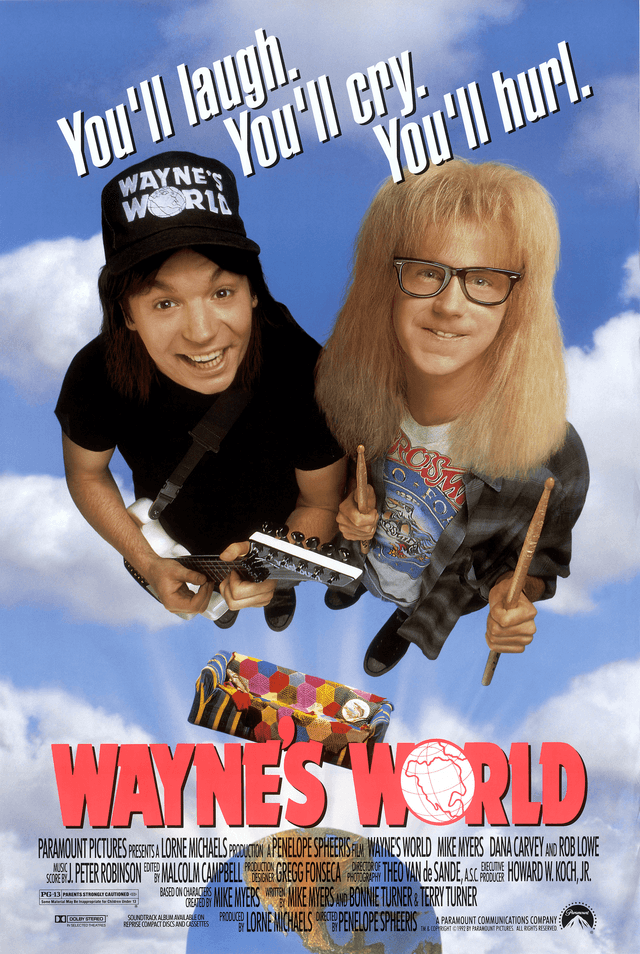
Wayne's World (1992)
Synopsis
"Wayne's World," released in 1992, is a cult classic comedy that follows the misadventures of Wayne Campbell, played by Mike Myers, and his best friend Garth Algar, portrayed by Dana Carvey. The duo hosts a public-access television show from Wayne's basement in Aurora, Illinois, where they showcase their love for rock music and quirky humor. Their lives take a turn when a slick television producer, Benjamin, played by Rob Lowe, discovers their show and offers to take it to a larger audience.
As Wayne navigates the challenges of fame, he also finds himself falling for Cassandra Wong, a talented bassist played by Tia Carrere. However, Benjamin has his own agenda, leading to a comedic battle for Cassandra's heart and the integrity of Wayne's show. With memorable catchphrases, iconic music, and a celebration of 90s pop culture, "Wayne's World" remains a beloved film that captures the spirit of friendship and the pursuit of dreams.
What is the budget of Wayne's World?
"Wayne's World," a comedy classic from 1992, has become a cultural touchstone for fans of the genre. Directed by Penelope Spheeris, the film stars Mike Myers as Wayne Campbell and Dana Carvey as Garth Algar. The movie's release not only entertained audiences but also set the stage for discussions about its financial aspects, particularly its budget.
The significance of the budget becomes clear when considering the film's impressive box office performance, which far exceeded its production costs.
What was the production budget of Wayne's World?
The production budget for "Wayne's World" was $20,000,000. This figure places it within a reasonable range for comedies of the early 90s, especially those that aimed for a broader audience. When compared to similar films from that era, such as "Dumb and Dumber" (1994) with a budget of $17 million, "Wayne's World" was slightly more expensive but ultimately delivered a higher return on investment.
Key Budget Allocation Categories
While specific breakdowns of budget allocation are not widely available, major cost factors typically include:
- Talent: Salaries for the lead actors and supporting cast.
- Locations: Filming in various locations, including the iconic basement set.
- Production Design: Creating the unique aesthetic that defined the film.
What were the major production costs?
Several elements contributed to the overall production costs of "Wayne's World." Notable expenses included:
- Talent Costs: The salaries of Mike Myers and Dana Carvey were significant, given their star power.
- Music Licensing: The film features a memorable soundtrack, which likely incurred substantial licensing fees.
- Special Effects: While not heavily reliant on effects, certain scenes required additional resources.
Challenges arose during production, particularly in managing the budget effectively. The initial budget of $20 million was adhered to, with no major overruns reported.
How did Wayne's World perform at the box office?
"Wayne's World" achieved remarkable box office success, grossing $183,097,323 worldwide. The domestic earnings alone reached $121,697,323, showcasing its popularity in the United States.
Break-even Point Analysis
To determine the break-even point, one must consider the production budget and marketing costs. Typically, a film needs to earn about double its production budget to cover all expenses. In this case, "Wayne's World" not only broke even but also generated a substantial profit.
ROI Percentage
The return on investment (ROI) for "Wayne's World" can be calculated as follows:
- Total Earnings: $183,097,323
- Production Budget: $20,000,000
- Profit: $163,097,323
This results in an impressive ROI percentage, highlighting the film's financial success.
Was Wayne's World profitable?
Absolutely, "Wayne's World" was highly profitable. The film's earnings far surpassed its production costs, making it a financial success for the studio. This success had a lasting impact on the comedy genre, influencing future projects and budgets.
Impact on the Studio and Franchise
The financial success of "Wayne's World" solidified its place in pop culture and led to a sequel, "Wayne's World 2," released in 1993. The film's profitability also encouraged studios to invest more in similar comedic ventures.
Future Movie Budgets in the Genre
The success of "Wayne's World" set a precedent for comedy films, demonstrating that a well-executed concept could yield significant returns. This encouraged studios to allocate larger budgets for future comedies, knowing the potential for high earnings.
Commonly Asked Questions
How much did Wayne's World (1992) cost to make?
The production cost of "Wayne's World" was $20,000,000.
Was Wayne's World (1992) profitable?
Yes, the film was highly profitable, grossing over $183 million worldwide.
What was the most expensive element of Wayne's World (1992)?
While specific figures are not available, talent salaries and music licensing were likely among the most expensive elements.
How much did Wayne's World (1992) make at the box office?
The film earned $183,097,323 globally, with $121,697,323 from domestic markets.
Did Wayne's World (1992) go over budget?
No, "Wayne's World" adhered to its initial budget of $20 million without major overruns.
In summary, "Wayne's World" stands as a testament to the potential profitability of well-crafted comedies. Its budget of $20 million was a wise investment, leading to significant box office earnings and a lasting legacy in film history.

































Budget Templates
Build your own production budget
Create professional budgets with AICP and feature film templates. Real-time collaboration, no spreadsheets.
Start Budgeting Free