
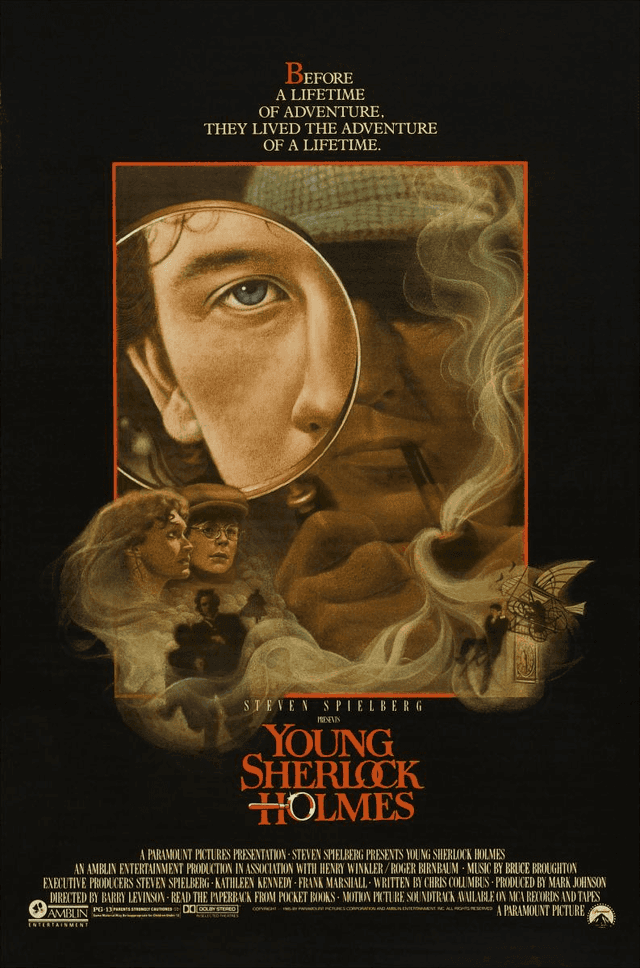
Young Sherlock Holmes (1985)
Synopsis
"Young Sherlock Holmes" (1985) takes viewers on an imaginative journey back to the formative years of the legendary detective, Sherlock Holmes. Set in Victorian London, the film follows a young Sherlock, portrayed by Nicholas Rowe, as he navigates the challenges of adolescence while honing his remarkable deductive skills.
The story begins when Sherlock enrolls at a prestigious boarding school, where he quickly befriends the spirited Watson, played by Alan Cox. Their camaraderie is tested when a series of mysterious deaths linked to a sinister cult begins to unfold. As the duo delves deeper into the investigation, they uncover a plot involving a deadly substance that can induce hallucinations, leading to a thrilling race against time to save their friends and unravel the truth.
With a blend of adventure, mystery, and a touch of humor, "Young Sherlock Holmes" captures the essence of friendship and the early beginnings of one of literature's most iconic characters. The film's innovative use of early CGI to create memorable sequences, along with its engaging storyline, makes it a beloved classic for both young audiences and fans of the detective genre.
What is the budget of Young Sherlock Holmes?
"Young Sherlock Holmes," released in 1985, is a captivating film that takes audiences back to the early days of the iconic detective, Sherlock Holmes. Directed by Barry Levinson, the movie features Nicholas Rowe as the young detective and Alan Cox as his loyal friend, Dr. John Watson. The film's imaginative storytelling and innovative use of early CGI have made it a cherished classic. Understanding the budget of "Young Sherlock Holmes" provides insight into its production and financial performance.
What was the production budget?
The production budget for "Young Sherlock Holmes" was set at $18,000,000. This figure places it within a competitive range for films of its genre during the mid-1980s. When compared to other adventure and mystery films of the time, this budget reflects the ambition of the project, especially considering the special effects and period settings that were integral to the film's appeal.
How does this compare to similar films in the genre?
In the 1980s, many films in the adventure and mystery genres had budgets ranging from $10 million to $30 million. For instance, "The Goonies" (1985) had a budget of approximately $19 million, while "The Princess Bride" (1987) was produced for around $16 million. "Young Sherlock Holmes" was positioned well within this spectrum, indicating a significant investment in its production quality.
What were the major cost factors?
Several key factors contributed to the overall production costs of "Young Sherlock Holmes":
- Special Effects: The film is notable for its pioneering use of CGI, which was a significant expense at the time.
- Locations: Filming in various locations to authentically recreate Victorian London added to the budget.
- Talent: The casting of experienced actors and the involvement of established production companies like Amblin Entertainment also influenced costs.
Were there any notable expensive scenes or elements?
One of the most memorable sequences involves a hallucination-inducing substance, which required extensive special effects work. This scene, along with others that showcased the film's innovative visual style, represented a considerable portion of the budget.
Did the film experience any budget challenges or overruns?
While specific details on budget overruns are not widely documented, the ambitious nature of the film's special effects likely posed challenges that could have impacted the final costs.
What was the box office performance?
"Young Sherlock Holmes" earned approximately $19,739,000 at the domestic box office.
How did the domestic vs. international breakdown look?
The film's earnings were primarily domestic, with international figures not widely reported. The domestic box office performance indicates a modest return on investment.
What was the break-even point analysis?
To break even, a film typically needs to earn about twice its production budget when considering marketing and distribution costs. Given its budget of $18 million, "Young Sherlock Holmes" would have needed to gross around $36 million to be considered financially successful.
What is the ROI percentage?
With a domestic box office of $19,739,000, the return on investment (ROI) can be calculated as follows:
- ROI = (Box Office Earnings - Production Budget) / Production Budget
- ROI = ($19,739,000 - $18,000,000) / $18,000,000 = 0.0977 or 9.77%
Was the movie profitable?
While "Young Sherlock Holmes" did not achieve blockbuster status, it did manage to recoup its production costs, albeit with a modest profit. The film's financial performance may not have met the expectations of its producers, but it has since gained a cult following.
How did it affect the studio/franchise?
The film's moderate success contributed to the reputation of Amblin Entertainment and showcased the potential for future adaptations of classic literary characters.
What impact did it have on future movie budgets in the genre?
The film's innovative use of CGI set a precedent for future productions, influencing how budgets were allocated for special effects in subsequent adventure and mystery films.
Did it set any records?
While "Young Sherlock Holmes" may not have set box office records, its pioneering visual effects were groundbreaking for the time, earning it a place in cinematic history.
Commonly Asked Questions
How much did Young Sherlock Holmes (1985) cost to make?
The production cost of "Young Sherlock Holmes" was $18,000,000.
Was Young Sherlock Holmes (1985) profitable?
Yes, the film was profitable, though its earnings were modest compared to its budget.
What was the most expensive element of Young Sherlock Holmes (1985)?
The most expensive elements were likely the special effects, particularly the innovative CGI sequences.
How much did Young Sherlock Holmes (1985) make at the box office?
The film earned approximately $19,739,000 at the domestic box office.
Did Young Sherlock Holmes (1985) go over budget?
While specific details on budget overruns are not documented, the ambitious special effects may have posed challenges that impacted final costs.
In summary, "Young Sherlock Holmes" serves as an interesting case study in film budgeting and financial performance. Its production budget of $18 million and subsequent box office earnings highlight the challenges and successes faced by filmmakers in the adventure genre during the 1980s.























Budget Templates
Build your own production budget
Create professional budgets with AICP and feature film templates. Real-time collaboration, no spreadsheets.
Start Budgeting Free